Why a Co-inventor of an AI Patent Wrote a Book
About What Happens After Patents Expire
The Constitution’s Article I, Section 8, Clause 8 grants Congress the power “to promote the Progress of Science and useful Arts, by securing for limited Times to Authors and Inventors the exclusive Right to their respective Writings and Discoveries.” It was written in 1787, more than two years before the first patent law, so its words are a limit on securing exclusivity by any means, not merely a rule for patent statutes. A secured restriction against competition must expire. The book’s claim is that in the roughly 58 percent of commerce built around moving vehicles, motorized equipment, and appliances, the two words “limited Times” have been removed from the Constitution in practice — by regulatory agencies, without an amendment and without a vote. The bill for that removal is measurable.
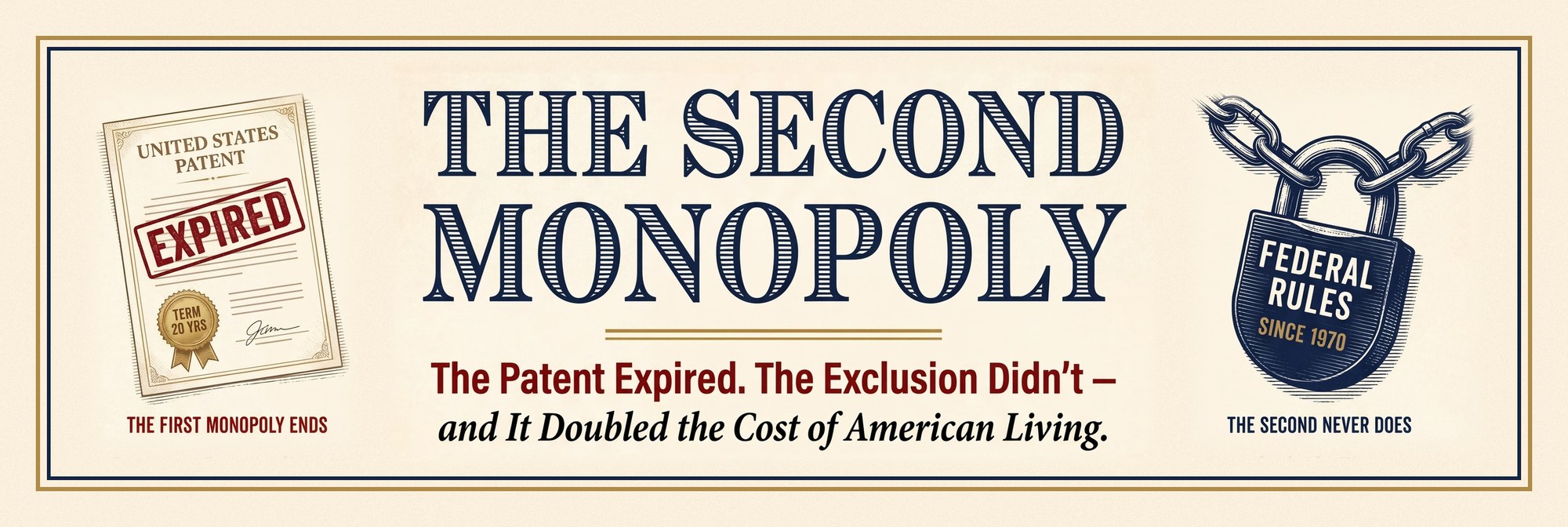
Those two words were written to make every patent monopoly end, so that once a patent expires the public may freely make the invention. For most of American history that is what happened, and prices fell. But since about 1970 a wall of federal regulation has quietly cancelled the public’s half of that bargain. The patent on a truck, a tractor, a furnace, or a light bulb expires on schedule. No rule forbids remaking it outright. But a faithful remake of a decades-old engineering design must meet standards written for new designs, which it can rarely satisfy without ceasing to be that design. In practice that is a ban, and it binds everyone. Not even the original maker may build its own expired design again. So the second monopoly is not one company’s right to an old design. It is the exclusion itself: the public is shut out of the expired-patent commons, and every incumbent maker is shielded from a cheaper remake of its own past work.
Three authorities name this exclusion a monopoly. The first is the Constitution’s own wording. The Patent Clause does not grant a sole right. It secures the exclusive Right — a right measured by the public it shuts out — and only for limited Times. The second is the definition the Founders inherited. Sir Edward Coke, the English jurist whose Institutes they studied, defined a monopoly as an allowance from the Crown, by grant “or otherwise,” to “any person or persons,” under which others are “restrained of any freedom or liberty that they had before.” By both measures the test is the public shut out, not the number of sellers.
The third is the Supreme Court’s own account of what a patent is. In Continental Paper Bag Co. v. Eastern Paper Bag Co. (1908), the patentee had never used its patented machine, and the Court still let it stop a competitor from using the design. Exclusion, the Court said, is “the very essence of the right conferred by the patent.” A monopoly needs no production; it needs only the power to exclude. When the patent expires, that power should end. Instead it passes to one federal rulebook, which still decides who may build the design — and its answer is no one. That is the “one” in monopoly. An exclusion that outlives the term breaks the Constitution’s limit however many makers it leaves standing, even none.
Until about 1970 the public lived with the expired-patent commons open. Since then, the cost of living has doubled against the median wage. Households now pay roughly double, relative to income, what their parents paid in 1970 for cars, pickup trucks, tractors, furnaces, light bulbs, and household appliances, whether the doubling is measured against wages or against prices in the roughly ninety nations where patent-expired remanufacturing is lawful. The result is a cost-of-living crisis that is, at its root, a constitutional one. The constitutional argument and the kitchen-table arithmetic are the same argument said in two different languages.
The reader does not have to take that argument on my word. In one of its chapters, this book puts the argument to an open examination. It hands the relevant Supreme Court holdings, the governing statutes, and a deliberately balanced brief — both sides given equal space — to independent artificial-intelligence models. It asks each, on its own, whether a real constitutional injury exists. I put that examination to eleven of them, built by rival companies and trained on different data. Among them was OpenCase, a legal-research model built for practicing lawyers and trained on the corpus of United States statutes and Supreme Court opinions. Every one agreed: on the authorities provided, the Patent Clause’s forgotten half states a genuine constitutional question that deserves its day in federal court. That is not proof the case will win. It is evidence that the question is real. The examination comes later in the book for a reason: the chapters before it supply everything it draws on, and the reader who follows the path laid out in the reading table below will arrive at it prepared — and able to run it personally.
Before You Begin: What to Read If Time Is Short
Read the Foreword first. Its author, Gord Magill, is a trucker who writes for truckers. No plaintiff category stands closer to this case than the men and women who drive semi-trucks for a living. The book’s highest ambition is that this legal argument sees its day in court. The drivers are the likeliest ones to carry it there. Start with their voice.
Magill is not a marginal voice. He is a working trucker who became one of the most widely heard chroniclers of the industry. He has written for Newsweek, The American Conservative, and American Affairs; publishes the Autonomous Truck(er)s Substack; and hosts the Voice of GO(r)D podcast. His 2026 book, End of the Road: Inside the War on Truckers, carries blurbs from Matthew B. Crawford, Oren Cass, and the executive vice president of the Owner-Operator Independent Drivers Association. He has carried the trucking story onto the two largest platforms of the populist right. He appeared twice on The Tucker Carlson Show — among the most-watched independent programs in the country, which through mid-2025 averaged on the order of a million views an episode on YouTube alone — and on Steve Bannon’s WarRoom, which streams several times each weekday and has ranked for years among the most popular political podcasts in the country. When such a writer agrees to introduce a constitutional argument, he carries it into the rooms where the coalition this book must reach already gathers. The Endnote Commentary gives the citations.
After the Foreword, the table below lists the essential sections, in reading order, for the reader whose time is short. The order is deliberate — the environmental answer comes before the international evidence, so the savings arrive with the objection already retired. Stop when satisfied. Rank 4 exists for lawyers and the legally curious; ordinary readers may skip it without loss.
Finish this Preface first, even if you intend to jump. Two of its sections do work the table cannot. The Question, the Author, and the Lateral Move says who is making this argument and why the question was available to him and not to the specialists who had every reason to ask it sooner. How This Book Is Documented says how to check any claim in the book against its source, which matters more here than in most books, because a reader who doubts an argument this large should not have to take a single sentence of it on trust. Ten minutes on the two of them will make everything the table sends you to easier to weigh.
How long will it take? At an average adult reading pace, the Rank 1 sections take about 45 minutes. Ranks 1 and 2 together take about two hours and twenty minutes. Ranks 1 through 3 take about three and a half hours. The full table, all four ranks, takes about five hours. Running the examination yourself — seven prompts through eleven models — adds roughly forty-five minutes of hands-on time beyond the reading. The whole book is a longer commitment; the table is the short road in.
| Section Title | Why Read | Rank |
|---|---|---|
| Chapter 35. When Outsiders Advance Constitutional Law and Other Disciplines | Read if you doubt that an outsider can move constitutional law forward, with or without the aid of AI, expertly and scrupulously used. If you are not in doubt, skip. | 1 |
| Picture Section: The Forgotten Half in 23 Images | The whole argument in 23 images. Ten minutes here shows what the regulations hide. | 1 |
| Chapter 1. Four Problems, One Remedy | The map of the book. Four problems, one constitutional remedy, stated plainly. | 1 |
| Chapter 6. Why Nobody Noticed: How a Constitutional Violation Hides in Plain Sight | Answers the first question every reader asks: if this is true, why has nobody said so? | 2 |
| Chapter 10. The Environmental Question: Why the Patent Bargain Does Not Unleash 1970s Emissions | Read this before the savings chapter. The remedy does not bring back 1970s smog. | 2 |
| Chapter 9. Why Wealthy Nations Break the Patent Promise That Poor Nations Honor | Not speculation. Ninety countries already allow remakes, with the savings priced across cars, trucks, semis, tractors, and combines. | 2 |
| Chapter 30. If a President Read This Book | The whole book in one story: the problem, the constitutional remedy, and the impact on the nation, told as a short fiction of how the case is won and what the country looks like after. | 2 |
| Chapter 24. The Patent Clause Prong: “Limited Times” as Constitutive Language | The first prong. Why “limited Times” means what it says. | 3 |
| Chapter 25. The Takings Clause Prong: Property the Government Cannot Cancel for Free | The second prong. What the government owes when it cancels a vested public right. | 3 |
| Chapter 34. What You Can Do: A Citizen’s Playbook | What one citizen can do, starting this week. | 3 |
| Chapter 20. Sovereign and Public-Fiduciary Plaintiffs | For lawyers: which sovereigns and public fiduciaries can sue. | 4 |
| Chapter 21. Direct and Associational Plaintiff Categories | For lawyers: the direct and associational plaintiffs with standing. | 4 |
| Chapter 23. The Filable Case: Why 2026 and Not Before | For lawyers: why the case is filable in 2026 and was not before. | 4 |
| Chapter 26. How a Remake Is Built and Certified | For lawyers and engineers: how a remake is built, certified, and kept honest. | 4 |
| Chapter 27. Objections Considered | For lawyers: the strongest objections, answered on what the cases actually hold. | 4 |
| Chapter 28. Reason the Constitutional Argument Yourself: The Open-Book Examination | For lawyers: hand the authorities to independent AI models and grade the constitutional question yourself. | 4 |
How Different Readers Might Approach the Rest of the Book
No two readers come to this book for the same reason. After the essentials above, follow the path that fits you.
The household reader. You feel the wall at the dealership and the grocery store. Go next to The $72,495 Pickup Truck, then How Prohibited Expired Patents Double Your Grocery Bill, then The Surveillance Premium. Finish with Five Years On: The Household Recovery. Those four chapters price the injury and the recovery at your own kitchen table. If the wall reaches your medicine cabinet as well as your driveway, add The Hindered (not Blocked) Sector, which covers the third of the economy that is not walled off outright but is held back — pharmaceuticals and medical devices, where the patent expires on schedule and the pathway from expiration to the patient does not.
The trucker and the operator. Your livelihood sits behind the wall. Read The Trucker’s Burden first — it is the constitutional brief for the American cab. Then The Last Human Driver, The Surveillance Premium, and The $72,495 Pickup Truck. After those, Five Years On: The Plaintiffs’ Recoveries. It shows what winning looks like for the drivers who file. Close with What You Can Do: A Citizen’s Playbook, because the plaintiff categories include you.
The historian. You want the bargain before the betrayal. Read Jefferson’s Bargain, then When the Bargain Worked, then The Bargain Still Works. Together they show two centuries in which expired patents entered the public domain and prices fell — and the three product categories where that engine still runs today.
The lawyer. Read Part V whole, in order, from Sovereign and Public-Fiduciary Plaintiffs through How a Remake Is Built and Certified, then Objections Considered, and the examination chapter, Reason the Constitutional Argument Yourself, where you can put the authorities to independent AI models and grade the question yourself. Give it two passes: one before you form a view, one after. Then test the foundation against Appendix A, which gives a plain-language note on every Supreme Court case the argument rests on.
The policymaker and the staffer. Start with The Wall Itself, which names the seventeen statutes. Then read If a President Read This Book, The Policy Framework After a Successful Ruling, and Hybrid Legislative Voting. The last shows how to keep the ratchet from resetting after the ruling.
The skeptic. Good. The book was built for you. Read The Environmental Question, then Why Wealthy Nations Break the Patent Promise That Poor Nations Honor, then Objections Considered. Then run the examination yourself: Reason the Constitutional Argument Yourself hands the authorities to eleven independent AI models and lets you grade the constitutional question without taking anyone’s word for it. The cases are cited for what they hold, and the inferences are flagged as inferences. Judge for yourself.
I. The Question, the Author, and the Lateral Move
The book is the public-facing brief for the litigant who eventually files this case in federal court. No such case has been filed in the fifty-six years the regulatory wall has stood. The body of the book explains why the question was never asked, why it can now be asked, what the remedy looks like, and what the citizen reading the book can do to push it toward a courtroom. This preface explains a different question: why I — a co-inventor of an AI patent, and neither a constitutional lawyer nor a litigator — came to be the one to write it.
I am a co-inventor of U.S. Patent No. 5,359,509, an early artificial-intelligence system for adjudicating health-insurance claims, once archived in the permanent research collection of the Smithsonian Institution. I spent thirty-four years inside the Information Technology department of a Fortune 25 health-care insurance company where my primary professional skills were troubleshooting complex code and database design. I got my B.S. from what is now Truman State University, with a triple minor in American literature, Russian literature, and physical science, and an M.A. in sociology from the University of Northern Iowa, with my thesis entitled “Towards an Holistic View of Social Policy Problems: An Heuristic Approach.” In 1978 I earned a diploma in data processing from Western Business College in Portland, Oregon, an institution that no longer exists.
Between 1990 and 1995 I founded, edited, and published ShareDebate International, one of the Internet’s first electronic magazines, documented in Tom Easton’s “Off the Main Sequence” (2006). It was a small journal whose contributors included Milton Friedman, Murray Rothbard, George Gilder, Doug Bandow, Eamonn Butler, Jerry Pournelle, Leonard Peikoff, three Prometheus-Award-winning science-fiction novelists, and Douglas Ostrom of the Japan Economic Institute.
Between 1998 and 2000 I was recognized as a Y2K thought leader, with sixty-one published articles, gave the keynote at the IQPC Y2K conference in London, and recognition by the U.S. President’s Y2K Council and the World Bank.
I am a lifetime member of the Sierra Club and a former Northern Nevada chapter treasurer, and a hiking trainer and trip leader for the Sierra Club there. For 24 years I backpacked for about a month (on average) each summer in the High Sierra. Plenty of time to think about the world away from civilization. I am seventy-six and live in Northern Kentucky, and write full-time. I founded the Make American Living Affordable (MALA) movement on X, on one of X’s largest communities which I created on election day 2024 and which has grown to more than 115,000 members. The more than 111 long-form articles I have written on the patent clause, Congressional history and complex social problems have drawn more than 7.8 million cumulative impressions.
I offer the biography, in compressed form, because the body of the book argues a thesis that disciplinary specialists — patent attorneys, environmental lawyers, regulatory economists, constitutional scholars — have spent fifty-six years not arguing. Why was this the man who saw it?
The honest answer is that an eclectic and cross-disciplinary background, the kind a career counselor would call unfocused, is the specific cognitive preparation — what Thomas Kuhn called the outsider’s vantage on a settled paradigm — needed to see across the field boundaries that specialists are trained to respect. The lateral move from patent law to environmental regulation to constitutional jurisprudence to consumer arithmetic is invisible to anyone whose paycheck depends on remaining inside one of those fields. It is visible to a person who has spent a working life moving across them. That is a claim about standing rather than about conclusions, and the section that follows puts evidence behind it.
My background is in software — first as a programmer, later as a database programmer. A compiler does not interpret intent. A compiler reads what you wrote, applies the language’s rules, and returns either an executable result or a compilation error. It does not consult the spirit of the document; it consults the syntax of the document.
That habit of mind, applied for long enough, becomes how a person reads any structured text. It is how I read the Constitution. When I read Article I, Section 8, Clause 8, I do not read it the way constitutional lawyers are trained to read it. In addition to looking at how the framers might have meant beneath what they wrote, or what the practice has settled into in the centuries since, I also look at it as a “line of code.” The phrase that arrests the compiler-reading mind is limited Times. It has a type signature. It is a duration. Durations have a start and an end. After the end, the resource — the right to copy and remanufacture the invention — enters the public domain. None of that is interpretation. It is just reading the line of code as written.
Constitutional lawyers are trained to find meaning in penumbras and emanations — in the long shadow a written document casts after centuries of judicial elaboration. The training is necessary. Most constitutional questions are not, in fact, simple syntax. But a few are. The Patent Clause, on the question of what happens at the end of the limited time, is one of them.
Three decades ago I built the first English-language webpage on how to play Janggi, Korean chess — a game whose name means Generals’ Game, and whose rules, like any rulebook, are not the spirit of the game but the game itself. A player who treats them as suggestions does not lose to a better strategist; he loses to the rulebook, because the rulebook is the only thing the position is being evaluated against.
What follows documents the habit of mind that made the lateral move feasible for one person working alone: the relationship to artificial intelligence.
II. The AI Paradox: Using the Tool to Disarm It
A book whose central concern is the cost of living for an ordinary American household cannot ignore that, in the year this book goes to print, the loudest single complaint Americans have about the technology industry is that artificial intelligence is coming for their jobs. The complaint is not unfounded. The first wave of large-language-model deployment is, by any honest measurement, displacing white-collar work in customer service, paralegal research, basic radiology, copywriting, junior accounting, and entry-level computer programming. The trucking industry’s roughly five million drivers face a more specific version of the same threat: autonomous-vehicle programs at multiple firms now operate fleet pilots whose internal cost-per-mile projections undercut the human-driver baseline, and the regulatory environment that produced that cost asymmetry was the environment that had already made human-operated trucks expensive enough to be undercut in the first place. The animosity Americans feel toward AI in 2026 is the rational response of people watching the economic ground move under them.
Even within that picture, the math has begun to move in unexpected directions. An Axios report from April 2026 documented that information-technology budgets at multiple firms now exceed payroll, with computing costs running, in at least one named case, well beyond the cost of the employees the AI was meant to replace. The proposition that machine labor will always undercut human labor on price is, even today, an empirical claim under pressure. The most reliable lever for restoring the American worker’s competitive footing is not to slow the deployment of the tool. It is to reduce the cost of what the worker’s wages must cover to live.
This book is, paradoxically, an AI-assisted answer to the AI-assisted problem.
The mechanism is straightforward. The book argues that restoring the right to remanufacture patent-expired durable goods — pickup trucks built on a 1990s Ford F-150 platform, tractors built on a 1970-era John Deere platform, furnaces built on a turn-of-the-century Carrier platform — lets a buyer who chooses the remanufactured good pay half or less of the new price, while competition pulls down the price of new goods themselves by roughly fifteen percent, as later chapters show. A pickup truck driver whose rig costs $25,000 instead of $72,495, whose furnace costs $3,000 installed instead of $18,000, whose appliances cost half of what they cost today, is operationally cost-competitive against the autonomous vehicle at a baseline the autonomous vehicle’s economics cannot match.
The semi-trucker chapter develops this point in detail: the human-driven, pre-2000-platform rig, freshly remanufactured to vintage-era federal standards, is the cost configuration that thwarts robotic replacement. The remedy the book proposes does not stop AI from being deployed in trucking. It changes the math underneath the deployment, so that the AI’s labor-displacing advantage becomes the advantage of a tool, not the advantage of a regulatory subsidy. The same logic applies, in their own forms, to long-haul drivers, delivery drivers, rideshare and taxi operators, agricultural-equipment operators, and the trades that depend on operating equipment rather than being replaced by it.
What makes the paradox most acute is that none of the analysis behind that argument could have been done, by me alone at a kitchen table in Northern Kentucky, without the same artificial-intelligence tools whose downstream consequences the book is trying to mitigate.
I am not a constitutional lawyer. I am not a patent attorney. I have never been licensed to practice law, never clerked at a federal court, never taught at a law school. The case the book makes — across Supreme Court doctrine — is the kind of case that, in the institutional configuration of American constitutional advocacy, would normally be assembled by a research team at a law-school clinic or a public-interest legal organization. I assembled it instead, a retired data engineer working with disciplined access to a small set of AI tools: Anthropic’s Claude for prose drafting and structural editing; Abacus AI’s DeepAgent for multi-step source retrieval; OpenCase, a legal model trained on Cornell’s Legal Information Institute datasets of United States statutes and Supreme Court opinions and indexed daily against open federal and state opinion archives, used to surface candidate authorities and to argue against the thesis; X’s SuperGrok for source material the other models cannot read; GPT-5 Thinking as a cross-model auditor of Claude’s output; Perplexity Pro for general research; Nano Banana Pro for visual production; and Meta AI, DeepSeek Pro, Microsoft Copilot, and Gab’s Arya as additional cross-model auditors and as respondents to the open-book examination. Every citation any tool produced was checked against the primary source before use.
On January 29, 2025, the U.S. Copyright Office published Copyright and Artificial Intelligence, Part 2: Copyrightability (copyright.gov/ai), concluding that works created by human authors using AI tools are eligible for copyright protection when the human provides substantial creative direction, selection, and arrangement. The Office confirmed that “the use of AI to assist in the process of creation or the inclusion of AI-generated material in a larger human-generated work does not bar copyrightability.” All constitutional arguments, litigation strategy, savings methodology, editorial structure, and substantive conclusions in this book are my own original intellectual work; AI tools served as research assistants and drafting aids under my direction across multiple working sessions.
The standard the Office applied is not a formality, and it is worth stating in the terms it used. Copyright attaches to what a human contributes — the selection, the arrangement, the creative direction — and not to material a machine generated on its own. A prompt is not authorship. What is protected is the judgment exercised over the output: what was kept, what was cut, what was wrong, what had to be checked again. On that standard the question of whether this book is mine is not close, and the manuscript record answers it.
The practical consequence for a reader is narrower and more useful than the legal one. A book assembled the way this one was assembled can be audited in a way a conventionally researched book cannot. Every authority is cited with a live link. Every figure is either checked against a primary source or marked as unchecked. Jamie Metzl’s openly AI-co-authored The AI Ten Commandments, published in 2026, took the same approach to disclosure. The appendix on AI-assisted authorship gives the full account of which tool did what, and the raw model replies to the examination are reproduced in Appendix C without editing. A reader who distrusts the method has more to work with here, not less.
Most people use AI the way a child uses Legos, snapping a few blocks together and deciding it can’t do anything sophisticated or new. Carpenters made the same misjudgment about power tools. Black & Decker’s portable drill appeared in 1916 and the portable circular saw in 1924, but hand labor ruled the job site until after World War II. Mark Erlich’s oral history of the Massachusetts trade (1986) records what happened when the Skilsaw finally arrived in force. The older men resisted, and they had cause. Early models carried marginal safety features. One carpenter watched a workmate nearly cut his leg off. Another hauled his Skilsaw to the roof and threw it off the building. “The saw’s too fast,” he said. “I’m going to cut by hand.” He was judging a tool by its worst version.
The unions saw the sharper problem. The tools were expensive, and if a contractor expected his men to supply them, the jobs would go only to the carpenters who could afford the price. In 1932 the Springfield, Massachusetts, District Council proposed fining any member twenty-five dollars for furnishing electric machinery to an employer. The fight was never against the saw. It was over who paid for it.
Both questions face anyone using AI now. An off-the-shelf chatbot is a fresh college graduate: quick, confident, and wrong often enough to cost you time. Training it is the first job — settings files, project files, a writing guide, response modes, cross-validation against rival models, self-audits, agent deep dives, and the plain fact that a chatbot is not an agent. The advanced tiers run past a hundred dollars a month, and without the subscription those models stay out of reach entirely.
Training the machine is the smaller half. Take a problem like the forgotten half of the Patent Clause. You have to be conversationalist, mentor, critic, debater, validator, and reader, often inside a single session. You have to bring your own library — history, law, engineering, economics — because the machine cannot tell you which discipline the answer is hiding in. You need a critical mind and the habit of thinking past the obvious. Linear logic checks the chain of reasoning. Lateral logic finds the chain worth checking. Without both, you will get fluent answers and never learn which ones were wrong. The Skilsaw did not make a man a carpenter. It made a good carpenter faster and a careless one dangerous.
As of 22 September 2026 this manuscript stood at forty-two files carrying one thousand one hundred sixty-six saved revisions between them — an average of twenty-eight per file. That total already counts the endnote apparatus, which was on its two hundred nineteenth version, the single most revised file in the book. A manuscript revised at that rate, for that long, is not the output of a prompt. It is the residue of a person deciding, several thousand times, what to keep, what to cut, what was wrong, and what had to be checked again.
That is a claim about standing, and it needs evidence rather than assertion. The evidence exists — not in law, where the record is thin, but in fields where an outsider’s result could be checked by something physical.
In 2023 a physicist with no training in papyrology downloaded scans of a carbonized Herculaneum scroll that hundreds of contestants and the whole papyrological profession already had, looked at them longer than anyone else had, and noticed a faint cracked-mud texture that turned out to be ink — the first evidence of writing ever found inside an unopened scroll. A twenty-one-year-old undergraduate read his blog post, trained a model to find more of it, and recovered the Greek word for purple. Papyrologists at Naples and Pisa then read the text and said whether it was Greek. In 2017 a software engineer put a neural network on the weak Kepler signals the professionals had reasonably skipped and surfaced an eighth planet around Kepler-90; an astronomer worked the problem with him and co-authored the paper, and the planet is listed in NASA’s archive alongside every other confirmed world.
The pattern is not that expertise proved unnecessary. Papyrologists read the Greek. An astronomer did the astronomy. What the outsider supplied was the question, and what the field supplied was the judgment about whether the answer was true. That is the whole claim, and the chapter When Outsiders Advance Constitutional Law and Other Disciplines sets out twenty cases of it — in law, medicine, geology, astronomy, linguistics, and financial regulation — with the four constitutional cases sharing one feature: the fact that moved the doctrine came from outside the law every time.
So this book does not claim to have been independently verified. It claims to be checkable, which is a different property and a more useful one. Every case, statute, and regulation it relies on is cited so that a reader can open it and see for himself. This book hands the reader the primary sources and invites him to reason the argument independently, and reports what happens when independent reasoners do. A former federal energy regulatory attorney has read successive drafts across a long correspondence, and disagreed with parts of them; I rewrote parts of Chapter 27, “Objections Considered”, in consequence. Practicing attorneys are now engaging with the argument publicly, under their own names and with their reputations attached. That is not a certification that the argument is right. It is evidence that people with something to lose consider it worth arguing with.
One thing belongs here plainly rather than left for a reader to discover on his own. Artificial intelligence made this analysis possible for one person working alone. Artificial intelligence is also, at this moment, putting fabricated legal citations in front of judges — Damien Charlotin’s public database logs the decisions that caught them, and by August 2026 it had passed nineteen hundred. The failure in every one of those cases has the same shape: somebody put his name on a citation he had not read. The remedy is not to put the tool down. It is to read the citation. Every authority in this book was opened.
The tools were not used as ghost-writers. They were used as a small newsroom. Claude drafted prose and edited structure. OpenCase verified citations against the authoritative federal record and twice flagged circuit-court conflicts my synthesis had missed. SuperGrok read X-published source material the other models could not read. DeepAgent ran multi-step source-retrieval workflows. GPT-5 Thinking was used as a cross-model audit on Claude’s drafts. Every claim of constitutional fact in this book was vetted against a primary source I personally examined. Every citation has a URL.
A word about what kind of author that makes me. I wrote many of the book’s sentences and some of its paragraphs myself, but I was also its composer, editor, and proof-reader. Before the baton was invented, composers led their own orchestras from inside them: Bach from the harpsichord, Mozart from the piano. Each played a part himself, but most of what the audience heard came from other players, and the composer decided what was played, in what order, at what tempo, and what was cut in rehearsal. Nobody doubted whose music it was. That is the right picture of how this book was made, and it changes what the reader is being asked to do. A conventional book of ideas asks you to follow one author’s thinking as it developed over a lifetime. This one asks you to ride along on a journey of exploration, through two centuries of American history and 197 years of Supreme Court rulings on what happens when a patent expires — a journey nobody had taken before, and nobody could have taken alone. Not for want of intelligence; for want of years. A language model can read the whole line of cases, every statute in the wall, and the economic and environmental literature around them in the time it takes a person to read one brief, and it can carry a rider down that path without losing the thread. That is a large part of why the book is new. The chapter Why Nobody Noticed explains why the question sat unasked for fifty-six years. The rest of the explanation is here: the reading path that answers it was longer than one working life, until now.
The constitutional question this book asks is not a math problem in the formal sense. But it is a kind of problem — cross-disciplinary, hidden in plain sight, defended by overlapping institutional incentives — that the human alone has likewise been unable to solve for fifty-six years.
The closer analogy is not mathematics but security. Three cases from the last two years share one shape: a system defended by experts, a flaw the experts never found, and a machine that found it by reading the rules. The first is Microsoft’s Bing. In March 2026 Microsoft published two critical advisories, each rated 9.8 on a scale of 10, for remote-code-execution flaws in Bing Images — one reachable through the public “search by image” upload that anyone can use. Both credit XBOW, an autonomous system that a year earlier had become the first non-human to reach the top of HackerOne’s United States leaderboard of vulnerability researchers. XBOW’s founder described Bing image search as one of the best secured systems in the world, very well secured by Microsoft’s engineers and hammered by thousands of hackers trying to get in.
The second is OpenBSD, the operating system whose developers audit every line and whose reputation for security is the best in the field. The code that handles internet connections — the TCP stack — carried a flaw for twenty-seven years that let a stranger crash the machine by opening a connection to it. Some of the most careful programmers alive read that code for a generation, and automated bug-hunters ran over it millions of times. In 2026 Anthropic’s Claude Mythos Preview found it. The third is SQLite, the small database engine embedded in nearly every phone, browser, and car. In July 2025 Google’s threat-intelligence group saw signs that an attacker was preparing to use an unknown flaw in it but could not tell which. They handed the fragments to Big Sleep, an AI agent built by DeepMind and Google’s Project Zero, which read the code, found the bug the attacker was about to use, and Google patched it first — the first time, Google said, that an artificial intelligence had foiled an exploit before it was used.
None of these systems was carelessly built. They were opened because a machine can hold every rule of a system in view at once and ask where the rules stop agreeing with each other. That is what this book does to a constitutional grant, the statutes written under it, and the regulations written under those: it reads them together and finds the place where they break.
It is not a coincidence that the year in which the book becomes writable is the year in which the tools became powerful enough to make it writable.
The book exists to argue that ordinary Americans can be paid more, in effective real income, by being charged less for what they buy.
AI is one of the reasons American workers in 2026 feel the floor moving. AI is also the reason this book could be written at all. If the argument succeeds, it hands those workers back half their old purchasing power.
III. The Search No One Has Run
If machines can read a system’s rules and find where they break, the natural question is whether anyone has pointed one at the system this book examines: the Constitution, the statutes passed under it, and the regulations written under those. I looked, and as far as I can find, no one has. The nearest thing is the government’s own effort. In July 2025 the Washington Post reported that the U.S. DOGE Service had built an AI tool to read roughly 200,000 federal regulations and flag the ones no longer required by law; it had already reviewed more than a thousand regulatory sections at the Department of Housing and Urban Development, and by the account of staff who used it, misread the statute more than once. That is a real use of the tool. But it asks a question one layer below this book’s. It asks whether a statute still requires a rule. It does not ask whether the statute and the rule, stacked together, do something the Constitution forbade.
Academic work has gone a step further in kind. A 2025 dataset built from rulings of Italy’s Constitutional Court trains models to recognize conflicts between statutes and constitutional articles — but only conflicts a court has already declared. Nobody, so far as I can find, has run the search downward from a constitutional clause, through the statutes and regulations built on it, to a live conflict no court has yet been asked about. That is the search this book runs, by hand and with the tools described above, on two words in Article I. The point of saying so is not priority. It is that the method is available to anyone, the sources are public, and the field is empty. I would be glad to be shown that someone ran this search first; a reader who knows of such a case should say so, and the correction will go in the next edition.
IV. How This Book Is Documented
The running text carries no superscript reference numbers. Sources, court cases, and statutes are gathered in the book’s Endnotes — hosted online, in full and continuously clickable, at marti124.github.io/Patent_EndNotes.
They are alphabetized by author surname or by case name, in the Chicago style. Each entry ends with a link — Justia for Supreme Court cases, Cornell’s Legal Information Institute for federal statutes, Founders Online for the founding documents, the publisher’s own page for everything else — so any reader can go straight to the source with a single tap. Where an in-text citation is needed, it sits inside the sentence in the form “Yandle (1983) named the pattern,” with the full reference held for the Endnote. An entry that rewards a longer note ends with the words See Endnote Commentary; that parallel section, alphabetized the same way, holds the fuller passages and the context the running text leaves out, for the reader who wants depth and the reader who would rather skip it. A page at the back of the book sets out everything the Endnotes contain and how to reach them.
Roleigh Martin
Northern Kentucky
Ready to test the argument yourself? The chapter Reason the Constitutional Argument Yourself: The Open-Book Examination hands you the primary materials and the seven prompts: Read the full examination chapter.
For an overview of what the book contains: the Book Brief.