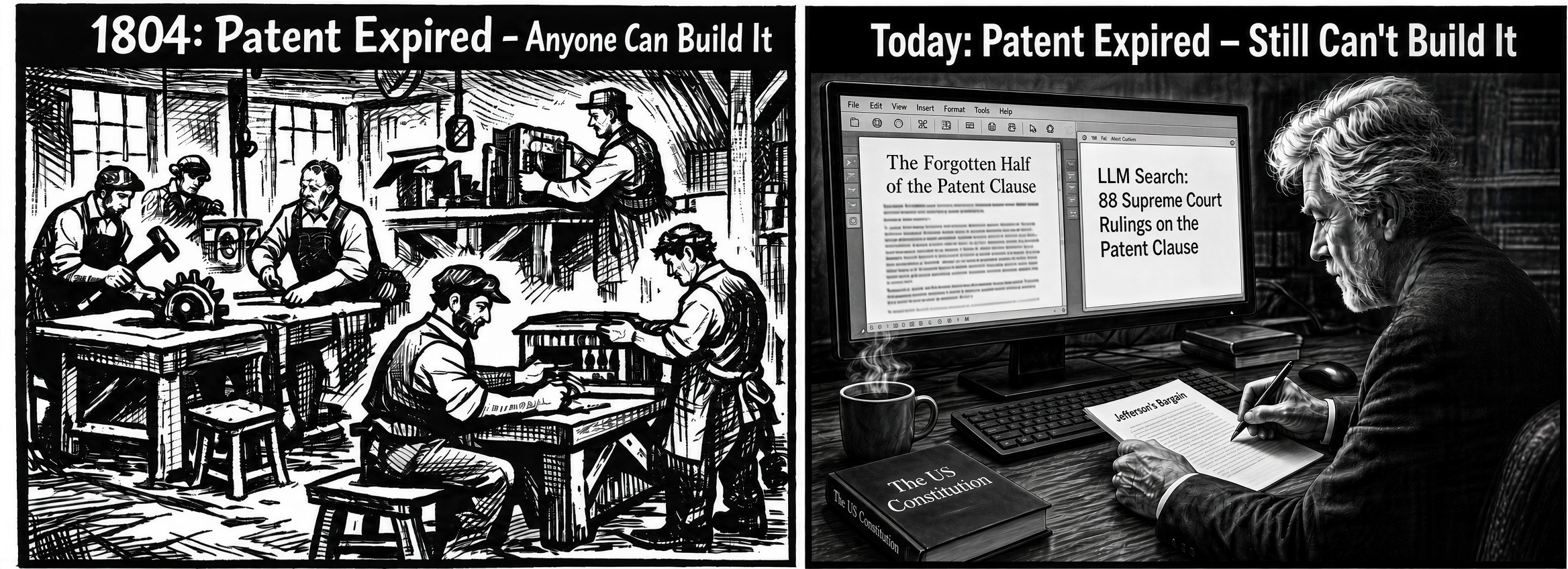
Left panel originally drawn by OpenAI’s GPT Image 1.5 and redrawn by Grok Imagine, which drew the right panel, under the artistic direction of the author.
For editors, publishers, and readers
The Case for Smart Exceptions to Editorial Policies on AI
Posted 13 October 2026, updated 18 October 2026. Every source is linked where it is cited.
Background
America faces astronomical problems today, and the written solutions offered for them are abysmally poor, as measured by the results they have obtained.
One example alone makes the point. According to the U.S. Treasury’s historical dataset of the nation’s outstanding debt, 1957 was the last fiscal year in which the government’s outstanding debt was lower than it had been the year before. People are confused about this, thinking the balanced budgets around 2001 prove otherwise. They forget that those surpluses counted money the government borrowed from the Social Security and other trust funds, and that borrowing is still debt. Despite a surplus in fiscal year 2000, the nation began fiscal year 2001 owing $17.9 billion more than a year earlier. In contrast, fiscal year 1957 closed with the nation owing $2.22 billion less than a year earlier. As the current fiscal year began on October 1, 2026, the outstanding debt stood at $40.17 trillion.
Yet the record shows 80 fiscal years in our nation’s history that ended with a lower outstanding debt than the year before.
This fact alone monumentally proves the problems are astronomical. Beneath it lies a Congress unable to function in a historically responsible manner. Looking deeper, legal AI engines analyzing the U.S. Constitution and the nation’s regulations helped me find a significant problem, one that, more than anything else, explains why our cost of living is nearly double what it was in 1970, comparing median income with the cost of big-ticket items.
I have developed a reproducible examination: give 31 significant Supreme Court holdings to large language models (LLMs) capable of legal analysis, OpenCase among them, and ask whether a constitutional conflict exists. All 11 models I tested concluded that it does, one of them after a follow-up question.
Yet nearly all the major policy magazines have policies against the use of AI, or allow it only for grammar checking or for research help that stays hidden behind the paper.
These policies are sound in general. In some cases they are counterproductive.
I understand the reason to reject AI slop. It is not only disgusting; it is most often wrong, and it cannot be copyrighted. A magazine or book publisher that prints it embarrasses itself.
Some magazines and book publishers allow AI to be used only invisibly, to find references and to help with grammar and spelling, but not to help organize paragraphs or improve sentences.
This latter policy can be counterproductive too. Applied without exception, it leaves me unable to see how conservative policymaking has a chance to make historic headway.
For centuries, the equivalent of AI help came from wealth and influence, and powerful authors had it. Research staff, legal aides, skilled secretaries, and historical assistants played a significant role in their writing. That is still the case today wherever the writer is connected with the highly captured professions: law, politics, and policymaking.
It is extremely rare for a magazine whose editorial policy downplays the use of AI to receive a policy paper that is truly historically notable. My argument is that the expert and intelligent use of AI enables some in the rest of society to bring great ideas to the table.
The problems facing America demand that smart exceptions be made where they should be made. This paper explains why such exceptions are needed, and how an editor can tell when one is deserved.
AI enables the rest of society to bring great ideas to the table
Most editorial policies on artificial intelligence imagine two writers. One uses no AI, or lets it fix commas. The other types a prompt and prints what comes out. The policy admits the first, bars the second, and lets a detector decide which is which.
There is a third kind of writer the policy cannot see, and I am one. I have worked one idea for a year and a half, saved more than 1,400 revisions across one manuscript and the writing that fed it, and used various models to consolidate each of those edits. The detector will read the manuscript as machine prose, because the machine typed the last draft despite over a thousand edits in its making. Without an exception, the policy then says it does not deserve print.
The writers whose names we know have always had consolidators. The old ones were people, hired, married, or born into the household, and they were invisible until they published. Dorothy Wordsworth walked past the daffodils on Ullswater with her brother on April 15, 1802, and wrote them into her journal that night; William wrote the poem in 1804, and she is not in it. Dostoevsky, facing a contract that would have cost him his copyrights, hired a 20-year-old stenographer in October 1866 and dictated The Gambler to her in four weeks; her Reminiscences tell the story. Sofia Tolstaya copied and edited War and Peace seven times through, at night, by candlelight, and kept diaries. Henry James dictated his late novels to Theodora Bosanquet’s typewriter for 10 years; in 1924 the Hogarth Press printed her account, Henry James at Work. Winston Churchill dictated to secretaries; Elizabeth Nel took his words from 1941 to 1945 and published Mr. Churchill’s Secretary in 1958. His six-volume The Second World War was assembled by a research team he called the Syndicate, whose three chief members, in the judgment of David Reynolds’s 2004 study, sometimes drafted whole chapters. Churchill thanked them at the front of each volume and took the Nobel Prize in Literature in 1953. Auguste Maquet outlined the plots and characters of The Three Musketeers and The Count of Monte Cristo; the publisher kept his name off the title page, and the court kept it off when he sued. John F. Kennedy won the 1957 Pulitzer Prize for Profiles in Courage; in 2008 Ted Sorensen wrote that he “did a first draft of most chapters.”
None of those books was turned away for it. Neither is the professor’s paper drafted by graduate students, the senator’s memoir written by a ghost, or the scientist’s results run by a laboratory of assistants. The help was always there for anyone who could pay for it, marry it, be born to it, or hold an office that came with a staff. It was never there for a retired data engineer at a kitchen table in Kentucky until the tools arrived. An editorial policy that admits every one of those books and allows no exception is not protecting the reader from machines. It is preserving a status quo unable to substantially attack our historical problems.
The policy forgets two histories at once: the assistant’s, above, and analogous tool breakthroughs. The Skilsaw story, told below, is a perfect example. Carpenters threw the saw off the roof for a generation; nobody now asks whether a house was framed by hand.
The soft disciplines need this more than the hard ones. The last chapter of my book, “When Outsiders Advance Constitutional Law and Other Disciplines,” collects cases, some of them set out below, in which a machine found, in records a field already held, what the field had looked past. Those are hard sciences with data. Law, policy, political science, and economics have records as old: statutes, regulations, 197 years of rulings. No machine had been pointed at them, because the people who hold those records do not write with the research staffs a laboratory keeps. If those disciplines keep frowning on collaborative, heavily edited, heavily cross-checked AI-assisted writing, their hardest problems will stay where they are.
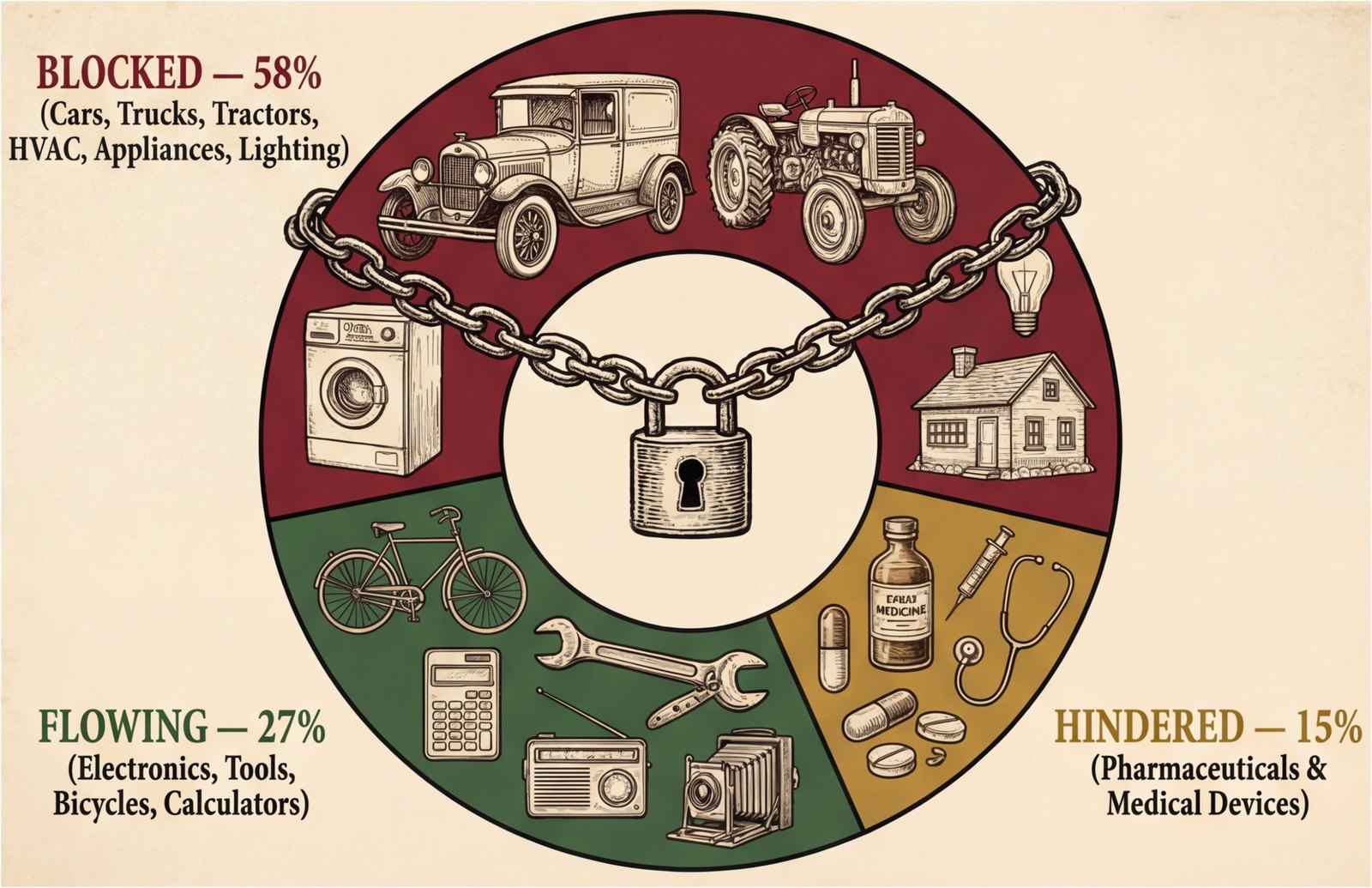
The expired-patent commons since 1970: where remaking an expired design is blocked, hindered, or still flowing.
The Patent Clause problem is a good test case. To state it, a writer has to hold at once the text and convention record of 1787; 89 Supreme Court rulings on patent expiry from 1829 to 2024; 17 federal statutes and the regulations several agencies wrote under them; the aviation certification record, type certificate by type certificate and Part 23 amendment by amendment; the national-accounts data behind a $22 trillion estimate; the engineering of what a faithful remake can and cannot carry; the prices in 90 countries; and the law of standing for 19 classes of plaintiffs across several circuits. That is six disciplines and two centuries. Before the tools, only an institution with a research staff and a budget, a law-school clinic or a public-interest legal organization, could attempt it. None did, in 56 years, because no institution’s incentives pointed there. A person without a staff could see the question and could not answer it. The machines were the staff. That is the whole of what they did, and it was enough.
AI enables the rest of society to bring great ideas to the table.
What use of AI should be acceptable in papers?
Copyright law has already drawn the line, and it is a sensible one. On January 29, 2025, the U.S. Copyright Office published Copyright and Artificial Intelligence, Part 2: Copyrightability. Material a machine generates on its own cannot be copyrighted, and a prompt alone does not make the person who typed it an author. A work a human makes with AI tools can be copyrighted when the human provides the creative direction, the selection, and the arrangement. In the Office’s words, “the use of AI to assist in the process of creation or the inclusion of AI-generated material in a larger human-generated work does not bar copyrightability.”
That is what “legally copyrighted” means for a writer who uses these tools. The law protects the judgment a person exercised over the machine’s output, and nothing the machine produced unattended. Slop fails that test because nobody exercised judgment over it. A book whose author chose the argument, the sources, the structure, and every final sentence passes it. The same standard leaves room for honest credit. In April 2026 Jamie Metzl named GPT-5 as co-author of The AI Ten Commandments, because that book presents what the machine synthesized from the world’s moral traditions. Where the machine’s synthesis is the content, naming it is honest disclosure. Where the argument is the author’s, the machine is a tool, and the author owes the reader an account of how it was used.
An editor can draw the same line and test it: open the citations and read the paper’s core, introductory argument. Most papers will never need an exception. For those that do, I propose that an editor grant one, whatever tools touched the paper, when it meets these conditions:
- The author conceived the argument and can show where and when it first appeared in print under the author’s name.
- Every citation opens to its primary source, every quotation matches its source word for word, and every figure is checked against one or marked unchecked.
- The author names the tools and says what each did.
- The author can defend any sentence in conversation with the editor.
- The revision record is available on request.
- The argument is internally consistent with its stated foundation, which one accepts as sound. In my case, it is Article I, Section 8, Clause 8 (the Patent Clause) of the US Constitution.
- The argument is structurally sound: beyond being internally consistent, the presented solution or analysis has a recognizable and persuasive structure.
- The analysis and solution add significantly to the history of writing on the problem. Where no writing legacy exists on the issue, writing that justifies its existence establishes one. The Forgotten Half of the Patent Clause is a great example of the latter.
- The argument resists misinterpretation: what readers understand is what the writer meant to convey.
- Where the work makes a claim an editor cannot check from the manuscript alone, the author publishes a test any reader can rerun: the materials, the questions, and the author’s own results, so the claim can be checked without taking anyone’s word for it, the author’s or an endorser’s. In my case, it is the open-book examination at https://marti124.github.io/Patent_Exam/, which gives 31 Supreme Court holdings and seven prompts to any model the reader chooses, with the replies of the 11 models I tested published unedited.
A manuscript that meets those conditions is not slop, whatever crafted its final draft, as in my case. The ten conditions do not all do the same job, though.
- Conditions 1 through 5 test honesty and process: the author conceived the argument, the sources open, the tools are named, every sentence can be defended, and the drafts are available. A paper that fails these, especially 2 and 4, is slop, whether a machine or a graduate student wrote it.
- Conditions 6 through 9 test quality: consistency, structure, contribution, and clarity. A paper that fails them is weak or ordinary, not slop. Most honest papers fail condition 8, and nobody calls them slop.
- Condition 10 applies only where the work makes a claim an editor cannot check from the manuscript alone. A paper with no such claim cannot fail it.
The AI achievements described later in this paper show the conditions sorting real work. The Herculaneum scrolls meet condition 10 in its purest form: the scans were released to the public as an open competition, so anyone could rerun the work. The Dead Sea Scrolls dating published its method in a peer-reviewed journal and tested the machine’s dates against radiocarbon dating and the judgment of paleographers. The 75-year error in a chemistry database is checked the simplest way, by reopening the original papers, which is condition 2. Jesse Waites’s archive finds rest on public records anyone can open, condition 2 again. Luke Stoffel’s memoir claims no discovery and makes no argument, so conditions 6 through 10 do not reach it; it shows that an author can use AI openly and be judged on the work. Conditions 6 through 9 were written for policy arguments, the kind of manuscript an editor of a policy magazine weighs, and the kind my book is.
A typical editorial AI policy lets writers use AI for research and for comments and suggested edits on early drafts, but requires the submitted draft to be conceived and composed by a human author. Conceived is the right test. Composed is where the policy stops measuring the writer and starts measuring the typing, and many such policies hand that judgment to a detector, treating a high score as decisive.
Detectors do not find a machine. They measure how predictable the wording is, and a paragraph revised for a year grows as predictable as a machine’s, because every pass trades an odd word for the clearest one. When I gave a 1,500-word magazine article of mine to 12 reviews by four AI model families, none called it machine-written: eight judged it likely human and four mixed. Yet the one paragraph all 12 flagged as machine-like was the one I had revised most by hand. I am in good company. In 2023 AI detectors scored the U.S. Constitution as written by AI, for the same reason: famous, much-copied, carefully worded text is predictable. That July, OpenAI withdrew its own detector “due to its low rate of accuracy.” A detector score can open a question for an editor. It should not settle one.
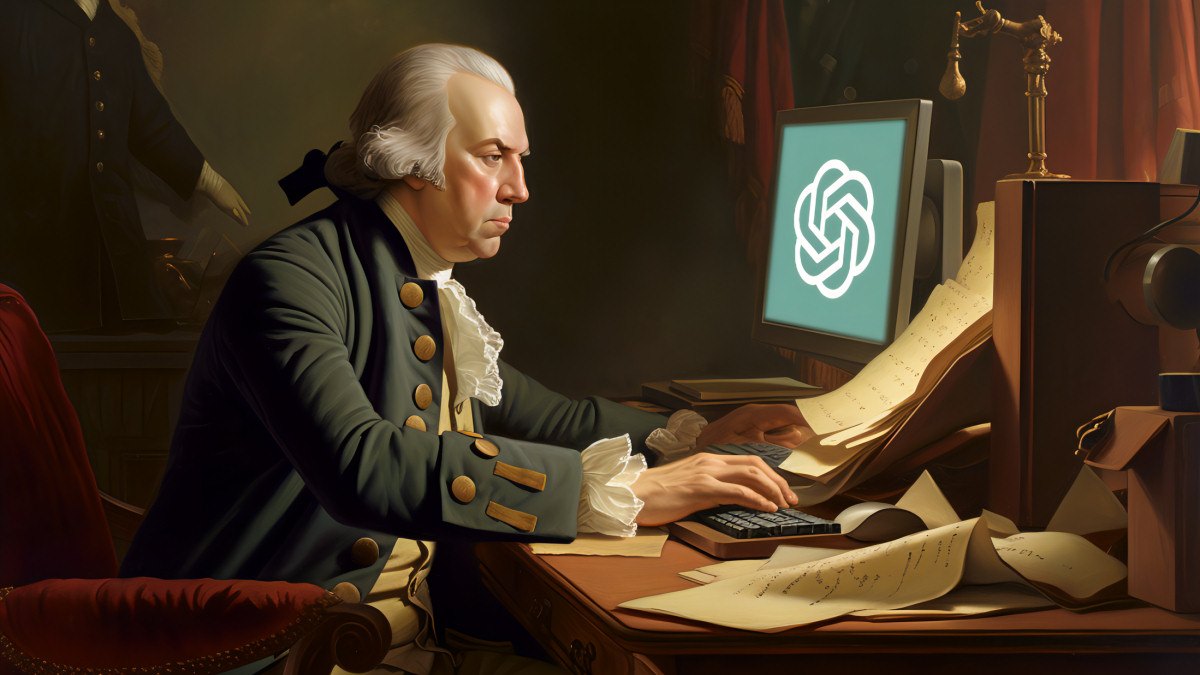
An AI-generated image of James Madison writing the US Constitution using AI. Credit: Midjourney / Benj Edwards
AI acceptance in writing is historically similar to how power tools were accepted in carpentry 100 years ago
Most people use AI the way a child uses Lego bricks, snapping a few together and deciding it can’t do anything sophisticated or new. Carpenters made the same misjudgment about power tools. The Skilsaw appeared in 1924, but hand labor ruled the job site until after World War II. Mark Erlich’s oral history of the Massachusetts trade (1986) records what happened when the Skilsaw finally arrived in force. The older men resisted, and they had cause; early models carried marginal safety features. One carpenter hauled his Skilsaw to the roof and threw it off the building. “The saw’s too fast,” he said. “I’m going to cut by hand.” He was judging a tool by its worst version.
An off-the-shelf chatbot is a fresh college graduate: quick, confident, and wrong often enough to cost you time. Training it is the first job: settings files, project files, a writing guide, response modes, cross-validation against rival models, self-audits, agent deep dives, and the plain fact that a chatbot is not an agent. The advanced tiers run past $100 a month. Training the machine is the smaller half.
Take a problem like the forgotten half of the Patent Clause. You have to be conversationalist, mentor, critic, debater, validator, and reader, often inside a single session. You have to bring your own library (history, law, engineering, economics) because the machine cannot tell you which discipline the answer is hiding in. You need a critical mind and the habit of thinking past the obvious. Linear logic checks the chain of reasoning. Lateral logic finds the chain worth checking. Without both, you will get fluent answers and never learn which ones were wrong. The Skilsaw did not make a man a carpenter. It made a good carpenter faster and a careless one dangerous.
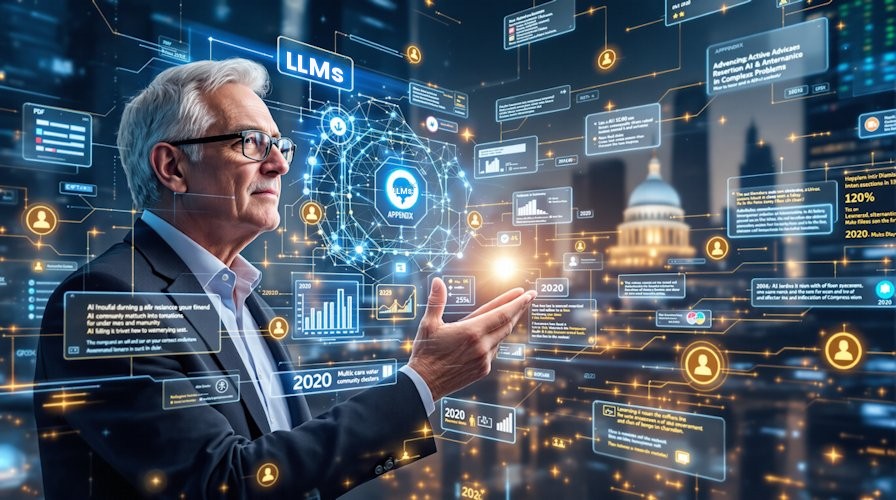
The maestro at work: an AI-generated illustration of one person directing several AI engines across law, history, and data.
Most editors now treat AI-assisted writing the way the carpenter on the roof treated the Skilsaw: they have seen the worst version and made a rule against the tool. The worst version is real. An unsupervised model will produce fluent prose with citations that do not open, and a publisher who prints it deserves what follows. As a default, the rule is sensible. Without exceptions, it protects against the wrong thing: it screens for the instrument when it should screen for the work.
In Writing Breakthrough Papers, AI Is the Great Equalizer
Samuel Colt’s revolver earned the nickname “the Equalizer.” As Smithsonian Magazine records it, “The old saying goes like this: God created men equal. Colonel Colt made them equal.” The writer Linda Hasselstrom, in her essay “A Peaceful Woman Explains Why She Carries a Gun,” gives a version that fits the frontier: “God made men and women, but Sam Colt made them equal.” With one, a woman, a smaller man, or a small party could travel the frontier with less fear, on equal terms with those who might otherwise have turned them away or pushed them around.
AI does the same for writers who have brains but neither wealth nor power. It lets them contribute to breakthroughs in nonfiction that once took a research staff and skilled, long-serving writing assistants. Why should conservative publications accept breakthrough nonfiction only from the wealthy and powerful, who can pay for that help? A magazine that defends the Second Amendment and the right of self-defense should be wary of the writing equivalent of harsh gun control. It is like a man with his own armed security detail arguing that ordinary people have no need of a gun.
What earns public trust in an armed citizen is training and responsible use, not giving up the gun. The same should hold for AI. What earns an editor’s trust is trained, disciplined use, measured by the ten conditions above, not abstaining from the tool.
Where AI use has proven itself capable of advancing human progress against unsolvable issues
The broken Patent Clause bargain is a kind of problem (cross-disciplinary, hidden in plain sight, defended by overlapping institutional incentives) that people working alone have been unable to solve for 56 years. The closest analogy is security. Three cases from the last two years share one shape: a system defended by experts, a flaw the experts never found, and a machine that found it by reading the rules.
In March 2026 Microsoft published two critical advisories, each rated 9.8 on a scale of 10, for remote-code-execution flaws in Bing Images; both credit XBOW, an autonomous system that a year earlier had become the first non-human to top HackerOne’s United States leaderboard of vulnerability researchers. OpenBSD, whose developers audit every line, carried a flaw in its internet-connection code for 27 years that let a stranger crash the machine; a generation of careful programmers missed it, and in 2026 Anthropic’s Claude Mythos Preview found it. And in July 2025 Google saw signs that an attacker was preparing to use an unknown flaw in SQLite, the database engine in nearly every phone, browser, and car; Big Sleep, an AI agent built by DeepMind and Google’s Project Zero, read the code and found the bug, and Google patched it first, the first time, Google said, that an artificial intelligence had foiled an exploit before it was used.
None of these systems was carelessly built. They were opened because a machine can hold every rule of a system in view at once and ask where the rules stop agreeing with each other. That is what my book does to a constitutional grant, the statutes written under it, and the regulations written under those: it reads them together and finds the place where they break.
Security is the closest analogy, not the only record. In 2023 a physicist with no training in papyrology noticed, in scans of a carbonized Herculaneum scroll the whole profession already had, a faint cracked-mud texture that turned out to be ink; a 21-year-old undergraduate trained a model to find more of it and recovered the Greek word for purple, and papyrologists then read the text. In June 2026 a whole scroll, judged unreadable since the 1980s, was virtually unrolled, and AI trained to find ink detected 20 columns of text in it. In 2017 a software engineer put a neural network on weak Kepler signals the professionals had reasonably skipped and surfaced an eighth planet around Kepler-90, now listed in NASA’s archive.
The medical cases take the operator’s credentials out of the argument, because the operators were insiders working their own field’s data. A system trained on retinal photographs from 284,335 patients estimated a patient’s age, smoking, and risk of a major cardiac event from the picture alone. A system called C-Path found that the ordinary tissue around a breast tumor predicted survival more strongly than the tumor did, on slides pathologists had read for decades. A Mayo Clinic system read a weak-pumping heart off an ordinary electrocardiogram and proved it in a randomized trial of 22,641 adults. In mathematics, AlphaTensor found a way to multiply certain small tables of numbers, in modulo-2 arithmetic, with fewer multiplications than the best method known since 1969.
Two things run through every one of those cases. The machine was not told where to look; it read what the field already had and asked where the pattern was. And a human being decided what counted as proved: papyrologists read the Greek, an astronomer did the astronomy, Mayo ran the trial, mathematicians checked the proof. The instrument was new. The information was not.
That is the exact shape of my book’s reading of 197 years of Supreme Court rulings on patent expiry: the records were public, the question had not been asked, and the machine could hold enough of the record at once to answer it. What counts as proved is still decided by people, and in this case that will be a court.
The record grows in 2026
The record kept growing in 2026, and it reached the archives. In October a software engineer, not a historian, pointed AI at 4.35 million pages of Dutch East India Company records and old newspapers. It surfaced an 1812 meteorite fall in India and three live Javan rhinoceroses shipped in 1738 to 1740, none of them in any catalogue, and he reports that specialists at the Geological Survey of India and the Rhino Resource Center confirmed both. In August Nature reported that a chemist’s AI model had disagreed with a reference database on boiling points, and his check of the original papers showed the database had been wrong for about 75 years. A year earlier, a model called Enoch dated the Dead Sea Scrolls from their handwriting, some of them 50 to 150 years older than thought; radiocarbon tests and paleographers backed it.
Book-length non-fiction is following. Luke Stoffel, a dyslexic painter who could not afford an editor and never had an agent, wrote his memoir with AI as copy editor and beta reader, said so in public, and won a 2026 IBPA Benjamin Franklin Award. He put the equalizer argument in one line: “AI didn’t lower the bar for talent. It lowered the bar for access.”
The most prestigious prize in American non-fiction has chosen disclosure over prohibition. The Pulitzer journalism entry form asks entrants to describe “any innovative techniques used in researching, reporting or telling the story, including AI tools,” and on June 24, 2026 the Board added a question for book entries asking entrants “to expound on whether they used any AI tools.” Only the photography categories require an attestation that no AI was used.
Using AI to solve the broken Patent Clause bargain
The problem sits in one clause of the Constitution. Article I, Section 8, Clause 8 was written in 1787, more than two years before the first patent law. Its words, “securing for limited Times to Authors and Inventors the exclusive Right...,” are therefore a constitutional limit on securing exclusivity by any means, not merely a rule for patent statutes. Since 1970, federal energy, emissions, and safety standards have raised a second exclusion that outlives the patent: a faithful remake of an expired engineering design must meet standards written for new designs, which it can rarely satisfy without ceasing to be that design.
What made “limited Times” arrest my eye is a habit from software. A compiler does not interpret intent. It reads what you wrote, applies the language’s rules, and returns either an executable result or an error. I read Article I, Section 8, Clause 8 that way. Limited Times has a type signature. It is a duration. A duration has a start and an end, and after the end the right to copy and remanufacture the invention passes to the public. Most constitutional questions need a lawyer’s training in meaning. A few are simple syntax, and this is one of them.
If machines can read a system’s rules and find where they break, the natural question is whether anyone has pointed one at the Constitution, the statutes passed under it, and the regulations written under those. I looked. No one has. The nearest thing, the AI tool the U.S. DOGE Service built in 2025 to read roughly 200,000 federal regulations, asks whether a statute still requires a rule, not whether the statute and the rule, stacked together, do something the Constitution forbade. My book runs that search downward, from two words in Article I through the statutes and regulations built on them, to a live conflict no court has yet been asked about.
The largest contribution the tools made was structural. Seeing that the public’s half of the Patent Clause had been withheld was the observation. Turning it into something a court can rule on is the work of Part V of my book, “Restoring the Patent Bargain: Who Can Sue and How,” and one person could not have assembled it without expert use of several engines at once. They helped identify the 19 plaintiff categories, and my part was to push back hard at every one, questioning, thinking, and verifying until a category survived or fell. They mapped how each plaintiff can reach a court at minimal cost, and how the same case can be filed in more than one circuit so that a conflict among the circuits makes it likely the Supreme Court takes the question. Holding all of it in one frame, consistent with 197 years of holdings, is what the machines made possible.
The book does not claim to have been independently verified. It claims to be checkable. Every authority is cited with a live link, and every one was opened before use. A former federal energy regulatory attorney read successive drafts across a long correspondence and disagreed with parts of them; I rewrote the first chapter in consequence. The open-book examination gives the 31 holdings to any model a reader chooses, and the book reproduces, unedited, the replies of the 11 models I gave it to.
Gord Magill, author of End of the Road: Inside the War on Truckers, wrote the book’s foreword and says he is no friend of AI content. He describes an author who “acted as a maestro in directing high end AI engines, specifically built for case law and legal research.” That is the standard an exception should meet. The question for an editor is not whether the author used the tool. It is how the author conducted it: chose the questions, set the machines on two centuries of holdings and a shelf of regulations, and checked what came back.
If the Supreme Court restores the Patent Clause bargain, a household that chooses newly built remakes of 20-year-old designs is projected, five years after the ruling, to recover a third to half of what it now spends on vehicles, appliances, and equipment; a household that buys nothing remade still recovers about 15%. The bottom 40% gain most. A policy with no room for a smart exception keeps that argument, and arguments like it, away from the people they would help.
The Wrap-up: How Does This All Relate to the Background’s One Example?
The Background’s prime example is the national debt: Congress reduced it in 80 fiscal years of the nation’s history, and not once since 1957.
Chapter 33 of my book, “Hybrid Legislative Voting: How to Stop the Ratchet from Resetting,” explains why the Patent Clause bargain was broken, how that could have been prevented, and how to repair it. Hybrid Legislative Voting re-introduces a voting option Congress had in its early history. Others and I argue that, with it, Congress would be better able to reduce the nation’s debt and to stop writing laws that serve lobbyists ahead of the Constitution.
Most of my book first appeared as X articles. I have written 35 long-form articles on Congress and the debt, including how Congress voted and met in committee before the 1970 Legislative Reorganization Act changed both, with the help of several LLMs. I have written 40 more on the broken Patent Clause bargain. Follow me on X at @RoleighMartin.